
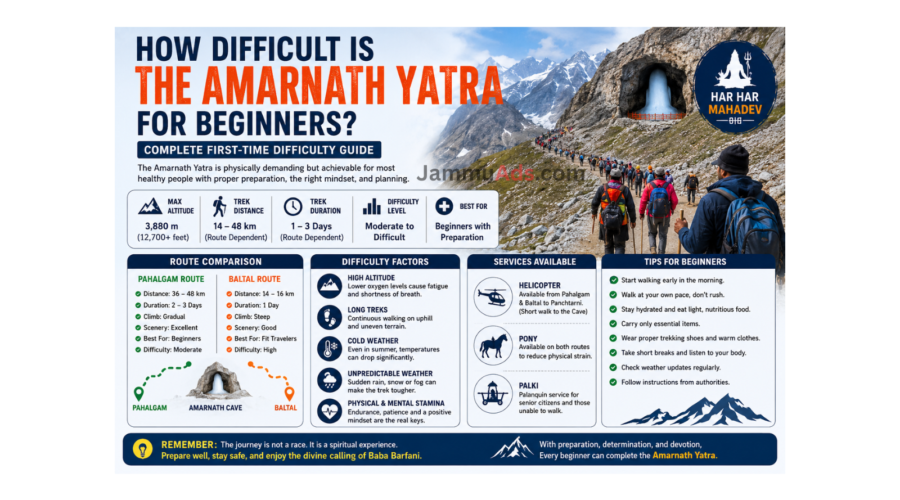
How Difficult Is the Amarnath Yatra for Beginners? Complete First-Time Guide
Quick Answer
If you’re wondering whether the Amarnath Yatra is difficult for beginners, the honest answer is:
Yes—but for most healthy people, it is manageable with proper preparation.
The journey is not technically dangerous like mountain climbing, but it is physically demanding because of:
- High altitude
- Long trekking distance
- Cold weather
- Low oxygen levels
- Steep mountain paths
- Unpredictable weather
Thousands of first-time pilgrims complete the yatra every year, including senior citizens and families. The biggest difference between those who enjoy the pilgrimage and those who struggle is preparation—not age.
If you prepare your body, choose the right route, carry the correct gear, and walk at a comfortable pace, your first Amarnath Yatra can become one of the most memorable spiritual journeys of your life.
Quick Facts
| Factor | Difficulty Level |
|---|---|
| Trekking | Moderate to Difficult |
| Altitude | High |
| Oxygen Level | Lower than plains |
| Suitable for Beginners | Yes, with preparation |
| Suitable for Children | Depends on age and health |
| Suitable for Senior Citizens | Yes (medical fitness required) |
| Pony Available | Yes |
| Palki Available | Yes |
| Helicopter Available | Yes |
| Best Fitness Preparation | 4–8 weeks |
| Maximum Altitude | Around 3,880 meters (12,700+ feet) |
| Average Trek Time | 1–2 days depending on route |
Every Beginner Asks the Same Question
The first time people hear about the Amarnath Yatra, they usually imagine one of two things.
Either they think it is just another temple visit.
Or they imagine an impossible Himalayan expedition.
The truth lies somewhere in between.
Imagine waking up before sunrise.
The mountain air feels crisp.
Clouds float below the peaks.
Pilgrims wearing colorful raincoats slowly begin climbing together.
Someone chants “Har Har Mahadev.”
Another family offers tea to strangers.
Army personnel encourage tired travelers.
Ponies quietly pass by.
You slowly realize that this isn’t just a trek.
It’s a journey shared by thousands of people who have come from every corner of India.
Some are experienced trekkers.
Many are walking in the mountains for the very first time.
That is exactly why beginners should understand what actually makes the journey difficult.
Not to become afraid.
But to prepare wisely.
Is the Amarnath Yatra Harder Than Most Temple Visits?
Absolutely.
Unlike most famous temples where vehicles take you almost to the entrance, the Amarnath Cave requires reaching a high Himalayan glacier region.
This means your body faces conditions that many people have never experienced before.
Some of the biggest challenges include:
- Walking at high altitude
- Sudden weather changes
- Continuous uphill climbing
- Reduced oxygen
- Cold temperatures even during summer
- Long hours of trekking
However, this does not automatically make the yatra impossible.
Every season, thousands of ordinary office workers, shopkeepers, teachers, students, homemakers, and retired people complete the pilgrimage successfully.
Many of them had never visited mountains before.
Preparation is what makes the difference.
Why Altitude Makes the Journey Difficult
Most beginners assume that the walking distance is the hardest part.
Actually, altitude creates the biggest challenge.
As you climb higher into the Himalayas, the air becomes thinner.
The amount of oxygen available in every breath gradually decreases.
Your lungs still breathe normally.
But every breath contains less oxygen.
This means your body has to work harder.
Even simple activities become tiring.
For example:
Walking 100 meters in your hometown may feel effortless.
Walking the same distance above 12,000 feet can leave you breathing heavily.
That surprises many first-time pilgrims.
It doesn’t necessarily mean something is wrong.
It simply means your body is adjusting.
This adjustment process is known as acclimatization.
Understanding it before your trip can help prevent unnecessary panic.
If you’d like to understand how altitude affects weather and oxygen levels during the pilgrimage, our guide on Amarnath Weather Forecast Live explains what conditions you can expect throughout the season.
What Makes Beginners Tired So Quickly?
Several small factors combine together.
Instead of one difficult obstacle, you experience many moderate challenges at the same time.
These include:
Continuous Uphill Walking
Unlike city roads, mountain paths rarely stay flat.
Your leg muscles remain active almost continuously.
Even experienced walkers notice the difference.
Lower Oxygen
Your heart pumps faster.
Breathing becomes deeper.
You may need more frequent breaks.
This is completely normal.
Cold Air
Cold temperatures force your body to use more energy simply to stay warm.
That is another hidden reason people become tired faster.
Heavy Backpack
Many beginners carry unnecessary items.
Extra weight quickly becomes exhausting after several kilometers.
A backpack that feels comfortable at home can feel much heavier on steep mountain trails.
Later in this guide, we’ll share a beginner-friendly packing checklist to help you carry only what you truly need.
Long Walking Hours
Most people underestimate how mentally tiring long trekking days can be.
Even if your body is strong, several hours of continuous walking demand patience.
Many experienced pilgrims say the journey is more about endurance than speed.
Comparing the Two Routes for Beginners
One of the biggest decisions you’ll make is choosing your route.
Both official routes eventually lead to the Holy Cave, but they offer very different experiences.
| Feature | Pahalgam Route | Baltal Route |
|---|---|---|
| Distance | Longer | Shorter |
| Steepness | Moderate | Very Steep |
| Scenic Beauty | Excellent | Good |
| Time Required | 2–3 Days | 1 Day |
| Suitable for Beginners | Excellent | Moderate |
| Physical Demand | Moderate | High |
| Rest Stops | More | Fewer |
Most experienced pilgrims recommend the Pahalgam route for first-time visitors.
Although it is longer, the climb is gradual.
Your body gets more time to adjust to the altitude.
The Baltal route is much shorter, but the steep ascent can feel much more challenging for someone who has never trekked before.
If you’re still deciding which route fits your fitness level, don’t miss our detailed comparison of Pahalgam vs Baltal Route for Amarnath Yatra, where we compare distance, scenery, safety, costs, and difficulty in detail.
Can Someone Who Never Exercises Complete the Yatra?
This is probably the most searched question every season.
The answer depends on your overall health.
Many people who don’t regularly visit the gym complete the pilgrimage successfully.
However, people who lead a completely inactive lifestyle usually find the trek much harder.
Think of two people.
One walks 30 minutes every evening.
Another spends almost the entire day sitting.
Both may be the same age.
Both may weigh the same.
But the first person usually adapts much better during the climb.
Walking regularly improves:
- Lung efficiency
- Leg strength
- Heart health
- Stamina
- Recovery speed
You don’t need marathon training.
Simple daily walking for several weeks before the pilgrimage can make a remarkable difference.
The Biggest Mistake First-Time Pilgrims Make
Many beginners save all their energy for reaching the cave.
Ironically, that’s often the wrong strategy.
Experienced yatris know something important.
The goal isn’t to walk fast.
The goal is to keep walking comfortably.
They maintain a slow rhythm.
They take short breaks instead of long ones.
They drink water regularly.
They avoid racing other pilgrims.
Those who rush often become exhausted much earlier.
Mountain trekking rewards patience—not speed.
How Cold Does It Really Feel?
One surprising fact catches almost every beginner off guard.
You may sweat while climbing.
Then, only fifteen minutes later, you may feel freezing because clouds move in or the wind becomes stronger.
Mountain weather changes rapidly.
A sunny morning can become rainy by afternoon.
Dense fog may suddenly reduce visibility.
Cold winds often become stronger near higher elevations.
That is why experienced pilgrims always dress in layers instead of wearing one heavy jacket.
Layers allow you to adjust quickly as temperatures change throughout the day.
Understanding this simple technique can dramatically improve your comfort during the trek.
Does Age Matter More Than Fitness?
One of the biggest misconceptions about the Amarnath Yatra is that younger people always find it easier than older people.
In reality, fitness often matters more than age.
Every year, you’ll see people in their 60s and even 70s walking steadily toward the Holy Cave, while some younger pilgrims struggle because they underestimated the trek.
The key difference isn’t birth year—it’s preparation, pacing, and overall health.
Let’s look at what beginners in different age groups can typically expect.
Difficulty Level by Age Group
| Age Group | Difficulty | Recommendation |
|---|---|---|
| 18–30 years | Easy to Moderate | Build stamina with regular walking |
| 31–40 years | Moderate | Begin cardio exercises 4–6 weeks before |
| 41–50 years | Moderate | Focus on fitness and health check-up |
| 51–60 years | Moderate to Difficult | Medical clearance and slower pace recommended |
| 60+ years | Depends on health | Only if medically fit and properly prepared |
Age should never be your only concern. Your doctor, your fitness level, and your ability to handle long walks are much better indicators.
Is the Yatra Difficult for Women?
Not necessarily.
Women complete the Amarnath Yatra every year in large numbers. Many travel solo, with family, or in organized groups.
The trek itself is not different for women than for men, but there are a few additional considerations:
- Wear comfortable trekking shoes instead of fashion footwear.
- Carry personal hygiene essentials.
- Pack an extra pair of warm socks.
- Stay hydrated throughout the trek.
- Avoid carrying unnecessary luggage.
Many women who have completed the yatra say that mental preparation was just as important as physical preparation.
The sense of community along the route also helps. Pilgrims often encourage one another, and volunteers provide assistance at many points.
Is the Yatra Safe for Solo Female Travelers?
Yes, if you follow official guidelines.
Thousands of solo women participate every year.
The routes remain busy during the official pilgrimage season, with security personnel, medical teams, volunteers, and fellow pilgrims present throughout the day.
For added comfort:
- Start your trek early in the morning.
- Stay with the main flow of pilgrims.
- Avoid trekking after official timings.
- Book accommodation in advance.
- Share your travel plans with family.
You can also read our detailed guide on Amarnath Yatra Safety Tips before planning your journey.
Is the Yatra Difficult for Overweight Beginners?
Being overweight doesn’t automatically mean you cannot complete the yatra.
However, carrying extra body weight increases the effort required during long uphill climbs.
Common challenges include:
- Faster fatigue
- Knee discomfort
- Shortness of breath
- Slower recovery after breaks
If you have a Body Mass Index (BMI) above the healthy range, it’s a good idea to begin preparing several weeks before your trip.
Even modest improvements in fitness can make a noticeable difference.
A Simple 6-Week Fitness Plan for Beginners
You don’t need expensive equipment or a gym membership.
A consistent routine is enough.
Weeks 1–2
- Walk 30 minutes every day.
- Climb stairs for 10 minutes.
- Stretch your legs after walking.
- Drink enough water daily.
Weeks 3–4
Increase your routine gradually.
- Walk 45–60 minutes.
- Include gentle uphill walking if available.
- Practice breathing exercises.
- Strengthen your legs with squats or step-ups.
Weeks 5–6
Prepare your body for longer activity.
- Walk with a light backpack.
- Aim for one long walk each week (8–10 km if possible).
- Practice walking at a steady pace without rushing.
- Continue stretching after exercise.
The goal is not speed. It is endurance.
Why Stair Climbing Helps More Than Running
Many beginners believe they should start running.
Running certainly improves cardiovascular fitness, but stair climbing often prepares you better for the Amarnath trek.
Why?
Because the pilgrimage involves continuous uphill movement.
Stair climbing strengthens:
- Calves
- Thighs
- Glutes
- Core muscles
It also trains your heart and lungs in a way that closely resembles mountain climbing.
If you don’t have access to hills, a staircase is one of the best alternatives.
Can Children Complete the Yatra?
Many families dream of taking children on this sacred journey.
Whether it’s suitable depends on several factors:
- Age
- Health
- Ability to walk long distances
- Weather conditions
- Altitude tolerance
Young children may become tired quickly or struggle with the reduced oxygen at higher elevations.
Parents should consult a doctor before making the decision.
Even if a child is energetic at home, mountain conditions are very different from everyday life.
What About Senior Citizens?
You’ll often see elderly pilgrims inspiring everyone around them.
Some walk slowly with trekking poles.
Others use ponies or palkis.
Many complete the pilgrimage with determination and careful planning.
If you’re above 60, consider these tips:
- Get a complete medical check-up.
- Carry all prescribed medications.
- Walk slowly.
- Rest whenever needed.
- Never ignore symptoms like dizziness or chest pain.
Remember, reaching safely is more important than reaching quickly.
Medical Conditions That Need Extra Attention
The Amarnath Yatra places additional stress on the heart and lungs because of the high altitude.
If you have any of the following conditions, consult your doctor before registering:
- Heart disease
- High blood pressure
- Asthma
- Chronic lung disease
- Diabetes
- Severe arthritis
- Recent surgery
Medical fitness isn’t just a formality. It’s an important step in ensuring your safety.
What Does Altitude Sickness Feel Like?
Many beginners worry about altitude sickness, but few know how to recognize it.
Common symptoms include:
- Headache
- Dizziness
- Nausea
- Fatigue
- Loss of appetite
- Difficulty sleeping
- Shortness of breath that feels unusual
These symptoms should never be ignored.
If they become severe, descend to a lower altitude and seek medical help immediately.
Along the official route, medical camps are available to assist pilgrims.
The Mental Side of the Journey
Physical fitness is only one part of the experience.
Mental preparation is equally important.
The trail can feel long.
The weather may suddenly change.
You may need to wait in queues.
Sometimes you’ll walk for hours before seeing significant progress.
Beginners who accept these realities beforehand usually enjoy the journey much more.
Instead of focusing only on reaching the cave, try to appreciate each stage of the pilgrimage—the mountains, the rivers, the chants of fellow devotees, and the peaceful surroundings.
A Story Many First-Time Pilgrims Can Relate To
Rakesh, a 35-year-old software engineer from Delhi, had never gone trekking before.
He spent most of his workday sitting in front of a computer.
When he registered for the Amarnath Yatra, he was nervous after reading stories online about difficult climbs.
Instead of canceling, he decided to prepare.
For six weeks, he walked every evening, climbed stairs at his apartment building, and reduced the weight of his backpack.
When the journey finally began, he was surprised.
Yes, the trek was challenging.
Yes, there were moments when he needed extra breaks.
But by maintaining a slow pace and staying hydrated, he completed the pilgrimage successfully.
Later, he said the hardest part wasn’t the mountain—it was overcoming the fear he had built in his mind before the trip.
His experience reflects what many first-time pilgrims discover: preparation changes the journey.
Which Route Is Easier for Beginners?
If this is your first Amarnath Yatra, choosing the right route can make a huge difference to your overall experience.
Although both routes lead to the Holy Cave, they feel very different.
Pahalgam Route: Best for First-Time Pilgrims
For most beginners, the Pahalgam route is the better choice.
Why?
Because the climb is spread over multiple stages instead of one continuous steep ascent.
Your body gets more time to adjust to the altitude, and you’ll find more overnight stops along the way.
Advantages
- Gradual climb
- Better acclimatization
- Beautiful Himalayan scenery
- More camps and facilities
- Less strain on the knees
The journey is longer, but many first-time pilgrims say it feels easier because they are not climbing steeply for long periods.
If you’re planning this route, our Amarnath Yatra Route Map guide can help you understand every stage before you begin.
Baltal Route: Shorter but More Challenging
Many beginners think the Baltal route is easier simply because it is shorter.
In reality, the opposite is often true.
The trail is much steeper.
That means you’ll gain altitude quickly while placing greater stress on your legs and lungs.
The route is suitable if:
- You’re physically fit.
- You’re short on time.
- You’ve completed mountain treks before.
For many first-time pilgrims, however, the Pahalgam route remains the more comfortable option.
Route Comparison
| Feature | Pahalgam | Baltal |
|---|---|---|
| Best for Beginners | ✅ Yes | ⚠ Moderate |
| Trek Duration | 2–3 Days | 1 Day |
| Climb | Gradual | Steep |
| Scenic Beauty | Excellent | Very Good |
| Rest Opportunities | Many | Limited |
| Fatigue Level | Moderate | High |
What If You Can’t Walk the Entire Trek?
Many people assume the only way to complete the Amarnath Yatra is by trekking.
Fortunately, that’s not true.
Several alternatives make the pilgrimage accessible to more people.
Helicopter Service
The helicopter is popular among:
- Senior citizens
- Families with limited time
- Pilgrims recovering from illness
- Those who cannot complete long treks
Keep in mind that even after the helicopter ride, there is still a walking section before reaching the Holy Cave.
If you’re considering this option, read our Amarnath Helicopter Booking Guide to understand booking, baggage limits, reporting times, and the remaining walking distance.
Pony Service
Ponies are available along both routes.
They’re especially useful for pilgrims who:
- Have knee pain
- Tire easily
- Want to conserve energy
- Are elderly
Always use officially registered pony operators.
Palki (Palanquin)
Pilgrims who cannot ride ponies can choose a palki.
This service is carried by trained porters and is commonly used by elderly devotees or people with mobility issues.
Although more expensive, it allows many people to complete the pilgrimage safely.
Essential Packing List for Beginners
Packing smart can make the journey much easier.
Many beginners either overpack or forget essential items.
Here’s a practical checklist.
Clothing
- Waterproof jacket
- Thermal innerwear
- Warm sweater or fleece
- Quick-dry trekking pants
- Woollen cap
- Gloves
- Rain poncho
- Extra socks
Footwear
Never wear brand-new shoes.
Instead, choose comfortable trekking shoes that you’ve already worn several times.
Carry:
- Trekking shoes
- Spare laces
- Lightweight slippers for camps
Health Essentials
- Personal medicines
- Pain relief spray
- Bandages
- ORS packets
- Water bottle
- Sunscreen
- Lip balm
- Hand sanitizer
Documents
Always keep:
- Yatra Registration Slip
- Government-issued ID
- Medical Certificate
- Hotel confirmations
- Emergency contact numbers
You can find the latest registration process in our Amarnath Yatra Registration Guide.
Common Mistakes Beginners Make
Learning from others can save you a lot of trouble.
1. Walking Too Fast
The mountains reward consistency, not speed.
Many beginners rush during the first hour and become exhausted before reaching the higher sections.
Walk slowly.
Maintain a comfortable rhythm.
2. Carrying Too Much Luggage
A heavy backpack becomes noticeably heavier with every uphill step.
Carry only the essentials.
If you’re unsure, ask yourself:
“Will I definitely use this during the trek?”
If the answer is no, leave it behind.
3. Ignoring Weather Forecasts
Mountain weather changes rapidly.
Always check conditions before starting each day’s journey.
Our Amarnath Weather Forecast page provides updated weather information throughout the yatra season.
4. Wearing Cotton Clothing
Cotton absorbs moisture and dries slowly.
Once wet, it can make you feel cold very quickly.
Instead, choose moisture-wicking or quick-dry clothing.
5. Skipping Meals
Some pilgrims avoid eating because they don’t want to feel heavy.
This often backfires.
Your body needs energy.
Eat light, nutritious meals and stay hydrated.
6. Not Taking Short Breaks
Waiting until you’re completely exhausted isn’t a good strategy.
Short breaks every 30–45 minutes help conserve energy.
7. Ignoring Your Body
If you feel severe dizziness, chest pain, or difficulty breathing, don’t push yourself.
Seek medical help immediately.
The pilgrimage is important, but your health comes first.
Local Tips from Experienced Yatris
People who complete the Amarnath Yatra regularly often share simple advice that makes a big difference.
- Start your trek before sunrise whenever possible.
- Drink small amounts of water regularly instead of waiting until you’re thirsty.
- Use a trekking pole on steep sections.
- Keep your rain gear within easy reach.
- Layer your clothing instead of wearing one thick jacket.
- Respect local customs and keep the mountains clean.
- Listen carefully to instructions from security personnel and volunteers.
These habits may seem small, but together they make the journey much smoother.
Beginner Planning Checklist
Before leaving home, make sure you’ve completed these steps.
One Month Before
- ✔ Register for the yatra.
- ✔ Obtain your compulsory medical certificate.
- ✔ Begin daily walking.
- ✔ Book accommodation.
- ✔ Reserve transport.
Two Weeks Before
- ✔ Test your trekking shoes.
- ✔ Buy warm clothing.
- ✔ Prepare medicines.
- ✔ Check weather trends.
One Week Before
- ✔ Pack your backpack.
- ✔ Print important documents.
- ✔ Inform family of your itinerary.
- ✔ Stay hydrated and get adequate rest.
On the Trek
- ✔ Walk slowly.
- ✔ Eat regularly.
- ✔ Stay hydrated.
- ✔ Dress in layers.
- ✔ Follow official advisories.
Can a Normal Person Do the Amarnath Yatra?
This is one of the most common questions asked by first-time pilgrims.
The simple answer is yes.
You don’t need to be a professional trekker, marathon runner, or mountaineer. Every year, thousands of ordinary people—including teachers, office employees, shopkeepers, homemakers, college students, and retirees—successfully complete the Amarnath Yatra.
The key is understanding that “normal” doesn’t mean “unprepared.”
Imagine someone who spends all day at a desk, never exercises, and decides to begin the trek without any preparation. They’ll likely find it much harder than someone who spends just 30–45 minutes walking every day for a month.
The mountains don’t test how strong you are. They test your patience, preparation, and ability to maintain a steady pace.
If you’re generally healthy and willing to prepare in advance, there’s every reason to believe you can complete the pilgrimage.
How Much Walking Is Required During the Amarnath Yatra?
The amount of walking depends on the route you choose.
| Route | Approximate Trek Distance | Typical Duration |
|---|---|---|
| Pahalgam Route | Around 36–48 km (over multiple stages) | 2–3 days |
| Baltal Route | Around 14–16 km (one way) | Usually completed in one day |
Although the Baltal route is much shorter, many pilgrims actually find it more exhausting because the climb is steeper.
The Pahalgam route spreads the effort across several days, making it feel more manageable for beginners.
If you’re planning your itinerary, our Amarnath Yatra Itinerary guide explains the ideal day-by-day schedule for each route.
Is the Amarnath Yatra Harder Than Kedarnath?
Many devotees compare these two famous pilgrimages before deciding which one to undertake first.
While both involve trekking in the Himalayas, the challenges are different.
| Factor | Amarnath | Kedarnath |
|---|---|---|
| Maximum Altitude | Higher | Lower |
| Oxygen Level | Lower | Better |
| Weather Changes | More Frequent | Moderate |
| Trek Distance | Depends on Route | Around 16–18 km |
| Best for Beginners | Pahalgam Route | Moderate |
| Main Challenge | High Altitude | Long Continuous Trek |
In general:
- Kedarnath tests endurance through a long, sustained climb.
- Amarnath challenges your body with higher altitude and thinner air.
Neither pilgrimage is “easy,” but with preparation, both are achievable for healthy travelers.
What Makes the Trek Feel Difficult?
When people describe the Amarnath Yatra as difficult, they’re usually referring to one or more of these challenges.
Thin Mountain Air
At higher elevations, your muscles receive less oxygen.
Even simple tasks can leave you breathing harder than usual.
Uneven Terrain
Unlike city roads, the trail includes:
- Rocky sections
- Mud after rainfall
- Snow patches (depending on the season)
- Narrow mountain paths
Good trekking shoes improve both comfort and safety.
Sudden Weather Changes
One of the most surprising aspects of the journey is how quickly the weather can change.
You might begin walking under clear blue skies and find yourself wearing a raincoat an hour later.
That’s why checking Amarnath Weather Forecast Live before starting each day’s trek is strongly recommended.
Mental Fatigue
Many beginners focus only on physical fitness.
But mountain trekking also requires mental resilience.
Long climbs, changing weather, and slow progress can become frustrating if you’re not mentally prepared.
Experienced yatris often say that staying calm and walking steadily is just as important as being physically fit.
How Can You Make the Trek Feel Easier?
While no one can eliminate the physical effort completely, several practical habits can make the journey significantly more comfortable.
Start Walking Early
Morning temperatures are generally cooler, and weather conditions are often more stable.
Starting early also gives you enough time to complete the day’s trek before evening.
Drink Water Frequently
Don’t wait until you feel thirsty.
Small, regular sips help prevent dehydration and reduce fatigue.
Eat Light but Regular Meals
Foods like bananas, dry fruits, energy bars, and simple meals provide steady energy without making you feel overly full.
Walk at Your Own Pace
One of the biggest mistakes beginners make is trying to keep up with faster groups.
Remember:
The pilgrimage isn’t a race.
A comfortable pace is almost always the fastest way to finish.
What Do Experienced Pilgrims Wish They Knew Before Their First Yatra?
Many repeat visitors share similar advice.
“I wish I had started exercising earlier.”
“I carried too many clothes.”
“I underestimated how cold the mornings would be.”
“The altitude affected me more than the distance.”
“Walking slowly actually helped me finish faster.”
Learning from these experiences can help you avoid the same mistakes.
Signs You’re Well Prepared
Before leaving for the pilgrimage, ask yourself these questions.
✅ Can I comfortably walk for one hour without stopping?
✅ Have I tested my trekking shoes?
✅ Have I completed my medical check-up?
✅ Have I packed light?
✅ Do I understand the route I’ve chosen?
✅ Have I checked the latest weather forecast?
If your answer is “yes” to most of these questions, you’re already much better prepared than many first-time pilgrims.
When Should You Postpone the Yatra?
Sometimes, delaying your trip is the safest decision.
Consider postponing if you have:
- High fever
- Chest infection
- Recent surgery
- Uncontrolled blood pressure
- Serious heart problems
- Severe breathing difficulties
The mountains will always be there.
Your health should always come first.
The Emotional Side of Completing the Journey
Nearly every first-time pilgrim remembers one particular moment.
It isn’t always the first glimpse of the Holy Cave.
Sometimes it’s helping another traveler climb a steep section.
Sometimes it’s sharing tea with strangers at a mountain camp.
Sometimes it’s hearing thousands of voices chant “Har Har Mahadev” together.
These moments remind you that the Amarnath Yatra is about more than reaching a destination.
It’s about perseverance, kindness, faith, and discovering strengths you may not have realized you possessed.
Expert Verdict: Is the Amarnath Yatra Too Difficult for Beginners?
For most healthy first-time pilgrims, the answer is no.
It is physically demanding.
It requires respect for the mountains.
It requires planning.
But it does not require extraordinary athletic ability.
If you prepare your body, listen to official advice, walk at a steady pace, and remain patient throughout the journey, your first Amarnath Yatra can become one of the most rewarding experiences of your life.
Frequently Asked Questions
1. Can beginners complete the Amarnath Yatra?
Yes. Most healthy beginners can complete the pilgrimage with proper preparation and a steady pace.
2. Which route is easiest?
The Pahalgam route is generally considered the easiest for first-time pilgrims.
3. Is gym training necessary?
No. Regular walking and stair climbing are usually enough.
4. How many days should I prepare?
Aim for at least 4–6 weeks of preparation.
5. Is altitude sickness common?
It can occur, especially in people who ascend too quickly or ignore symptoms.
6. Can I wear sports shoes?
Good-quality trekking shoes are recommended over regular sports shoes.
7. Is the trek dangerous?
The official route is well-managed, but mountain conditions require caution and preparation.
8. Can senior citizens go?
Yes, if they are medically fit and follow official guidelines.
9. Can children join the yatra?
Some children can, but parents should consult a doctor before planning the trip.
10. Is the helicopter completely risk-free?
Helicopter services reduce trekking distance but still require walking at high altitude.
11. How much water should I drink?
Drink small amounts regularly throughout the trek.
12. What is the hardest section?
Many beginners find the steep climbs and reduced oxygen at higher altitudes the most challenging.
13. Should I hire a pony?
If you have health concerns or limited stamina, it can be a helpful option.
14. What happens if it rains?
Rain is common. Carry waterproof clothing and follow official instructions.
15. Can I complete the yatra in one day?
The Baltal route allows this for many pilgrims, but it is physically demanding.
16. Is mobile network available?
Connectivity is limited and varies by location. Don’t rely on continuous internet access.
17. Do I need travel insurance?
It’s not mandatory, but it is a sensible precaution for a high-altitude journey.
18. What’s the biggest tip for beginners?
Don’t compete with other pilgrims. Walk at your own pace and enjoy the journey.
Final Thoughts
The Amarnath Yatra is challenging—but it isn’t reserved for athletes or experienced trekkers.
What makes this pilgrimage special is that people from every walk of life complete it each year. You’ll meet students, office workers, retirees, families, and first-time mountain travelers, all sharing the same path with faith and determination.
For beginners, the journey is less about speed and more about preparation. A few weeks of walking, the right clothing, careful packing, and realistic expectations can transform a difficult trek into a deeply rewarding experience.
When you finally stand before the Holy Ice Shivling after crossing valleys, rivers, and mountain trails, you’ll understand why millions of devotees consider this one of India’s most unforgettable spiritual journeys.
